
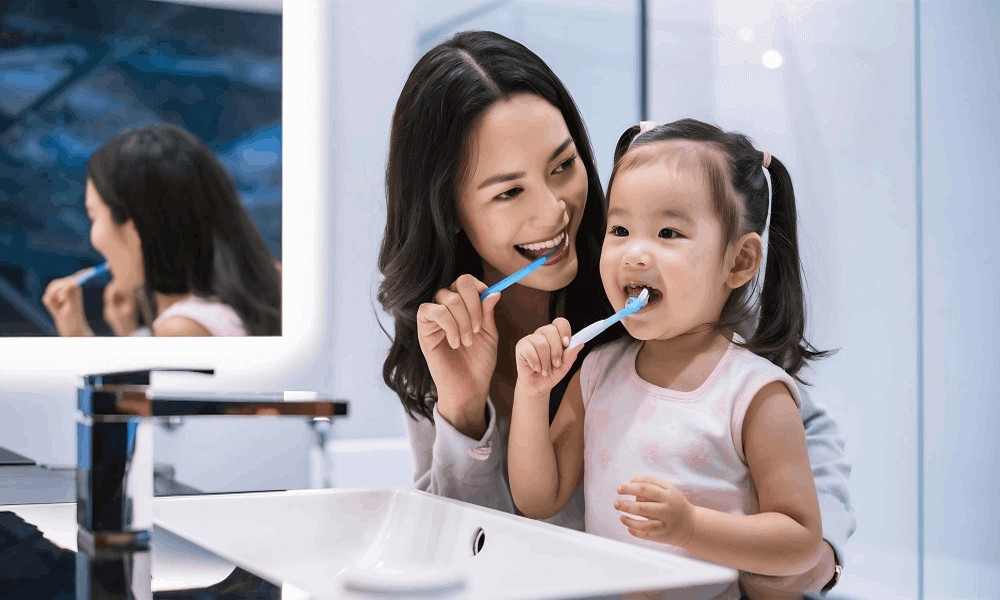
You might be feeling a quiet worry every time your child smiles. Maybe you notice a bit of plaque on their teeth, a stubborn snack habit, or a battle every night over brushing. You want to protect their smile, but between busy evenings, limited time, and confusing advice online, it can feel easier to just hope for the best and deal with cavities if they come. A Rancho San Diego dentist can help you feel confident you’re making the right choices for your child’s oral health.
Then there is the “after” that you want instead. A child who brushes without a fight, who sees the dentist and leaves with a clean bill of health, and a home where teeth are simply part of daily care, not a source of guilt or stress. That is what thoughtful preventive dental care at home can create.
Here is the simple truth. When you model a few consistent habits, you give your child one of the strongest forms of protection against cavities and dental pain. You do not need special gadgets or a perfect routine. You just need to show them what everyday care looks like and repeat it until it feels normal for your family.
This guide walks through 4 practical habits you can model at home, why they matter, and how to start even if your current routine feels messy. You will see how small changes now can save you money, time, and a lot of stress later.
Why does preventive dental care at home feel so hard to start?
On paper, oral care sounds simple. Brush, floss, watch the sugar, see a family dentist. In real life, you are juggling tired kids, homework, sports, screens, and your own long day. Because of this tension, you might wonder how much these habits really matter.
They matter a lot. Tooth decay is one of the most common chronic diseases in children in the United States. The Centers for Disease Control and Prevention explains that cavities can cause pain, infections, and missed school days, but are largely preventable with good daily care. You can read more about the broader impact of oral health on children through the CDC’s oral health resources.
Think about two different evenings.
In the first, it is late, everyone is tired, and you skip brushing “just this once.” Then it happens again on a busy night, and again after a long weekend. Your child learns that brushing is optional and linked to stress.
In the second, you might still be tired, but you say, “We always brush, even when we are sleepy. I will do it with you.” You stand at the sink together, even if it is quick. Your child learns that caring for their teeth is a normal, non-negotiable part of the day, like buckling a seatbelt.
That difference adds up over months and years. So where does that leave you now, especially if your current routine feels inconsistent or chaotic?
What gets in the way of strong home dental habits for kids?
There are a few common roadblocks that many parents face.
1. Power struggles and resistance
Your child might clamp their mouth, run away, or get upset when it is time to brush. It can feel like you are fighting the same battle every night, and eventually it is tempting to give in. When brushing becomes a tug-of-war, everyone is exhausted.
2. Confusion about what “good enough” looks like
You hear that children should brush twice a day, but for how long, and with how much toothpaste, and when do they start flossing? Without clear answers, you might do “some” brushing and hope it is enough. The American Dental Association offers simple guidance on brushing, flossing, and home care in their home oral care guidelines, which can help clarify the basics.
3. Worry about cost and dental visits
If you have had expensive dental work yourself, you may feel a knot in your stomach wondering what will happen if your child gets cavities too. The good news is that strong preventive habits at home often reduce the need for costly treatment. Regular checkups with a family dentist then become a way to maintain health, not just fix problems.
So how do you move from worry and inconsistency to confident, daily habits you can model at home?
These four habits form the core of effective preventive dental care for kids. When you model them yourself, your child is far more likely to copy and keep them.
Habit 1: Brush together, twice a day, for two minutes
Children learn by watching you. If they never see you brush, it feels like something “for kids” that adults outgrow. Try brushing your teeth at the same time as your child, morning and night. Stand next to each other at the sink. Make it a short shared routine instead of a task you supervise from the doorway.
Key points to model:
- Use a soft toothbrush and a pea-sized amount of fluoride toothpaste for children age 3 and older. For younger toddlers, use a smear the size of a grain of rice.
- Brush all surfaces. Outside, inside, and chewing surfaces of each tooth.
- Use a gentle, circular motion instead of scrubbing hard.
- Keep brushing for a full two minutes. A simple timer or song helps.
For younger children, you will still need to do the actual brushing for them or finish the job. You can say, “Your turn first, then my turn to make sure we get them extra clean.” That keeps them involved while you protect their teeth.
Habit 2: Make flossing a normal nightly step
Flossing removes food and plaque between teeth where a brush cannot reach. Many adults skip it, so children often do too. When you floss your own teeth where your child can see you, and then gently help them floss, you send the message that this is just what people do to stay healthy.
For young children, floss picks can be easier to handle than traditional floss. You can say, “We are cleaning the spaces where the toothbrush cannot go.” Start with the teeth that touch, usually the back molars, and work forward as more teeth come in and touch each other.
Habit 3: Treat sugary snacks and drinks as “sometimes,” not everyday
Even with perfect brushing, frequent sugar can overwhelm the teeth. It is not only candy. Juice, sports drinks, sticky fruit snacks, and constant grazing all feed cavity-causing bacteria.
Modeling here means being honest about your own habits. If your child sees you sipping soda all day, “no soda for you” feels unfair. If you treat water as your main drink and keep sweets to planned moments, it feels more natural for your child to do the same.
Helpful shifts to model:
- Offer water as the default drink between meals.
- Keep sweets with meals instead of constant snacking. The mouth then has time to recover.
- Avoid sending your child to bed with milk or juice. Only water at bedtime.
You do not need to cut all treats. You just want to avoid a steady drip of sugar all day.
Habit 4: Talk about the dentist as a partner, not a punishment
Children pick up on your feelings about dental visits. If you speak with dread, they will too. If you speak about the dentist as someone who helps keep everyone’s teeth strong, it feels safer.
Try saying things like, “Our dentist helps us keep our smiles healthy,” or “We go so they can check that our brushing is working.” When possible, schedule your own checkup and talk about it calmly. Your comfort becomes their comfort.
The National Institute of Dental and Craniofacial Research offers clear information on why home care combined with professional visits protects teeth for the long term. You can explore more through their overview of good oral hygiene habits.
How do home habits compare to relying on the dentist alone?
You might wonder how much difference these everyday habits really make if your child already sees a dentist. A simple way to look at it is to compare “home care plus regular checkups” with “minimal home care and only problem-based visits.”
| Approach | What it looks like in daily life | Common outcomes over time |
|---|---|---|
| Strong home habits plus regular preventive visits | Twice daily brushing with fluoride toothpaste, some flossing, mostly water between meals, checkups and cleanings every 6 to 12 months | Fewer cavities, lower chance of dental pain, shorter and less costly appointments, children who see oral care as normal |
| Minimal home care and problem-based visits | Inconsistent brushing, little or no flossing, frequent snacks and sugary drinks, visits only when there is visible decay or pain | More cavities, higher chance of emergency visits, more fillings and extractions, higher costs, children who may fear the dentist |
Most families fall somewhere in between. The encouraging part is that you do not have to be perfect to see real benefits. Any step toward more consistent home care and preventive visits with a family dentist reduces risk.
3 simple steps you can start this week
You might be wondering how to begin without turning your evenings upside down. Here are three focused steps that can fit into busy family life.
1. Create a “2 by 2” brushing ritual
Commit to this rule for your household. Everyone who has teeth brushes 2 times a day for 2 minutes. Morning and night. Set a timer on your phone or use a favorite two minute song. Stand at the sink with your child, brush your teeth too, and narrate what you are doing in simple language.
Consistency matters more than perfection. If you miss a morning, do not dwell on it. Just return to the habit at night.
2. Choose one sugar habit to change
Instead of trying to overhaul everything, pick one thing. Maybe it is replacing afternoon juice with water, limiting candy to weekends, or stopping bedtime bottles of milk once teeth have erupted. Explain to your child in age appropriate terms. For example, “We want your teeth to be strong, so water will be your bedtime drink now.”
Small changes, kept over time, protect teeth more than big, short lived efforts.
3. Put the next dental checkup on the calendar
If your child has not seen a dentist in the past year, schedule a visit with a family dentist near you. Tell your child what to expect. “They will count your teeth, clean them, and make sure the sugar bugs are not hurting them.” Treat the visit as part of routine health care, like a checkup with the pediatrician, not as a reaction to a problem.
Before the visit, keep your home habits going. Brushing, flossing where teeth touch, and water between meals help the dentist give you better news and fewer treatment decisions to worry about.
Bringing it all together for your child’s smile
You do not need to be a perfect parent or have a perfect routine to protect your child’s teeth. You just need to model a few steady habits. Brushing together, flossing the teeth that touch, choosing water more often, and treating dental visits as normal all send the same message. “Your teeth matter, and caring for them is something we do every day.”
When you show that care with your own actions, your child learns more than any lecture could teach. Over time, those small moments at the bathroom sink and in the kitchen shape a future with fewer cavities, less pain, and more confident smiles.
If you feel behind or overwhelmed, you are not alone. Start with one habit today. Add another next week. Reach out to a trusted family dentist to support you. You and your child deserve a routine that feels calm, clear, and protective of the smiles you love.
